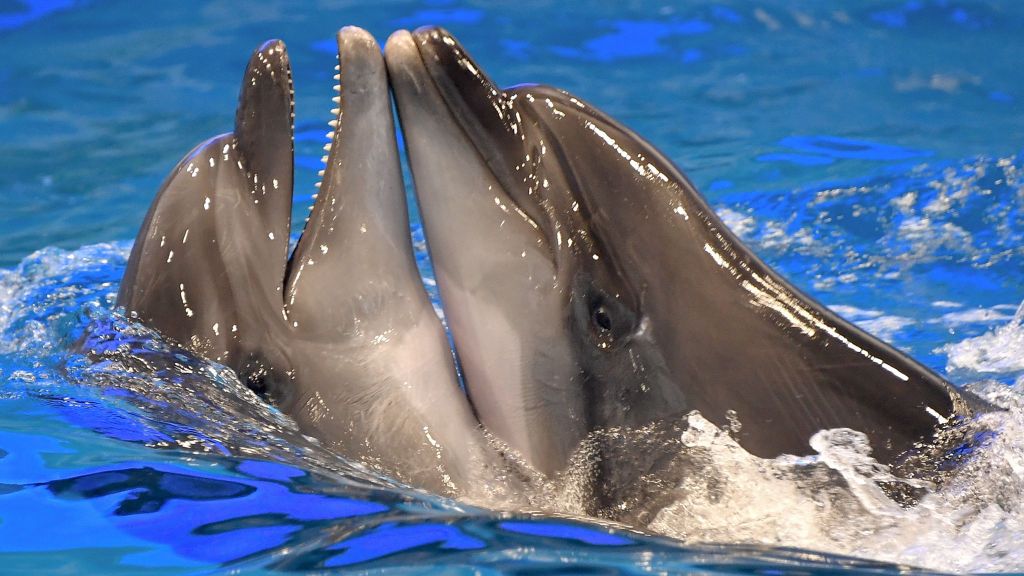
I read an article the other day that talked about the personality traits of dolphins and how scientists found they shared ‘similar’ personality traits to humans. The researchers stressed they weren’t identical, however it made me wonder – could there be an archetypal basis for personality? That beyond the human race, pervades nature…
The most widely accepted model for human personality centres on 5 traits: Openness, Extraversion, Conscientiousness, Agreeableness, Neuroticism. I’ve seen somewhere that these could also be organised as biased towards structure (conscientiousness, agreeableness, neuroticism) or update (openness & extraversion), which fits nicely into the yin-yang dichotomy, as many things do.

From the article: “Dolphin & human brains are considerably larger than their bodies require for basic bodily functions; this excess of brain matter essentially powers their ability to be intelligent, and intelligent species are often very curious.”
Could it also be posited that larger brains enhance, or grow from, a requirement of enhanced sociability – especially in animals with big, complex social groups, such as humans. Existing in large social groups necessitates balancing acceptance by the group, with climbing the social hierarchy. Could these dual requirements, that also exist in many species beyond humans, lead to an archetypal representation of personality traits throughout nature?
Intelligent species are “often very curious”. Some may consider curiosity a spandrel amidst brain matter that has developed with the intention of procreation and survival, the perceived focus for all other biological entities. In biology, a spandrel is a phenotypic trait that is a by-product of some other characteristic, rather than a direct product of adaptive selection.
Let’s take a slightly different perspective – procreation & survival for what? Purely for more procreation/survival? A materialist views curiosity either as a spandrel or a tool – to achieve more procreation and longer survival, but what if curiosity was the driving force and procreation was the tool?
“What if curiosity was the driving force and procreation was the tool?”
TF
Curiosity is consistent across many species. Is this the manifestation of a playful/explorative urge that exists in all living things? In order to maximise exploration over time, some stability would be required – this fits Robert Pirsig’s idea of Static and Dynamic ‘Quality’, from his book, Lila. Static Quality represents the patterns left behind by Dynamic Quality. Dynamic Quality is the explorative urge in all things, manifested through acts of creation and destruction. Dynamic Quality aligns with the Hindu idea of Lila, which they define as divine play; the play of creation and destruction and re-creation – the folding and unfolding of the cosmos.
The creative/destructive urge is easy to spot in children when we watch them play. Even for newborn babies, exploration is how they interact with the world around them. So while this exploration may be the driving force of existence and the universe, it still requires structure/stability as a foundation, to be able to manifest across time. This ‘structure’ is what we see all around us – patterns left behind. Our bodies the pattern of what we’ve previously consumed and how we’ve previously acted, our cities the pattern of multiple layers of civilisation built on top of, and around, each other.
So both exploration (update) and stability (structure) must be present throughout the universe for exploration to be maximised. Too much stability and everything would decay – the creative urge dies; too much exploration, too quickly, and the creative urge destroys itself, with no structure left to build upon.
This interaction of structure/update therefore plays out at multiple levels of existence – including the social and individual levels of humanity. Ego enables structure and stability at the individual level. As explorative beings, implicitly programmed to also look for stability in order to survive, we are susceptible to over-identifying with these stable structures (just as we are also susceptible to over-identifying with update & dynamic exploration). At the societal level, over-identification with stability can play out in greater numbers of the population associating with overly conservative political viewpoints, or through nationalism – built on the idealisation of old representations of national cultures; ‘the good old days’.
So any archetypes of personality aren’t just archetypes of personality, but archetypes of being – manifested through polarised traits. At the metaphysical level then there is value in all; in traits expressed at every point along each personality continuum. Isolated they may not make sense, or fit in with particular environments (consider the concept of wartime & peacetime leaders). They can only really be understood as part of the whole, as part of the eternal explorative dance of existence.
TF
 Some Words Left Behind