“We are all apprentices in a craft where no-one ever becomes a master.”
– Ernest Hemingway
Category: Wisdom
Notes & Thoughts Re: ‘The Tao of Physics’ by Fritjof Capra
As modern science has progressed it’s progressed towards a ‘truth’ that’s been evident to Eastern mystics for thousands of years – everything is interrelated and interdependent on everything else, and our consciousness shapes the world around us. This idea is consistent with the ‘ecological worldview’ which recognises the interdependence of all phenomena and the embedded ness of individuals and societies in the cyclical processes of nature. Another area of particular interest is quantum field theory. In this theory the classical contrast between solid particles and the space surrounding them is completely overcome. The quantum field is seen as the fundamental physical entity; a continuous medium which is present everywhere in space. Particles are merely local concentrations of the field; concentrations of energy which come and go, thereby losing their individual character and dissolving into the underlying field.
“We may therefore regard matter as being constituted by the regions of space in which the field is extremely intense… There is no place in this new kind of physics both for the field and matter, for the field is the only reality.” – Albert Einstein
Quoted from the Tao of Physics:
‘Like Einstein, the Eastern Mystics consider the underlying entity as the only reality: all its phenomenal manifestations are seen as transitory and illusory. This reality of the Eastern Mystic cannot be identified with the quantum field of the physicist because it is seen as the essence of all phenomena in this world and consequently, is beyond all concepts and ideas. The quantum field, on the other hand, is a well-defined concept which only accounts for some of the physical phenomena… …In the Eastern view, the reality underlying all phenomena is beyond all forms and defies all description and specification. It is therefore often said to be formless, empty or void. But this emptiness is not to be taken for mere nothingness. It is, on the contrary, the essence of all forms and the source of all life… … Being transient manifestations of the Void, the things in this world do not have a fundamental identity. This is especially emphasised in Buddhist philosophy which denies the existence of any material substance and also holds that the idea of a constant ‘self’ undergoing successive experiences is an illusion.’
TF
“Isn’t time important?” She asked.
“Not as much as we think.” He replied.
“Can you let the window be open? Can you let the rain or the sunshine or the butterfly come in?”
– June Singer
Time = Comparison
Eternity = Acceptance
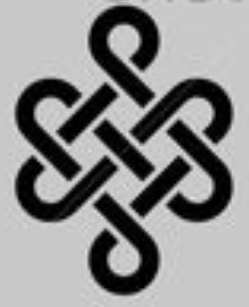
The Endless Knot
An ancient symbol depicting the ultimate unity of everything. It represents the interweaving of the spiritual path, the flowing of time & the movement within That which is eternal. All existence is bound by time & change, yet ultimately rests serenely within the Divine and Eternal.
Kierkegaard:
‘…the most common despair is to be in despair at not choosing, or willing, to be oneself; but that the deepest form of despair is to choose to be another than himself. On the other hand to will to be that self which one truly is, is indeed the opposite of despair, and this choice is the deepest responsibility of man.’
(Excerpt from ‘On Becoming a Person’ by Carl Rogers)
“The agony of breaking through personal limitations is the agony of spiritual growth. Art, literature, myth & cult, philosophy, and ascetic disciplines are instruments to help the individual past his limiting horizons into spheres of ever-expanding realisation.”
– Joseph Campbell
Your constraints are your freedom.
The following applies to coaching athletes as much as dealing with psychiatry patients…
Carl Jung on the Doctor/Patient relationship and methods in psychology:
Anyone who wants to know the human psyche will learn next to nothing from Experimental Psychology.
He would be better advised to put away his scholar’s gown, bid farewell to his study, and wander with human heart through the world. There, in the horrors of prisons, lunatic asylums and hospitals, drab suburban pubs, in brothels and gambling-hells, in the salons of the elegant, the Stock Exchanges, Socialist meetings, churches, revivalist gatherings and ecstatic sects, through love and hate, through the experience of passion in every form in his own body, he would reap richer stores of knowledge than text-books a foot thick could give him, and he will know how to doctor the sick with real knowledge of the human soul.
It is enough to drive one to despair that in practical psychology there are no universally valid recipes and rules.
There are only individual cases with the most heterogeneous needs and demands – so heterogeneous that we can virtually never know in advance what course a given case will take, for which reason it is better for the doctor to abandon all preconceived opinions.
This does not mean that he should throw them overboard, but that in any given case he should use them merely as hypotheses for a possible explanation.
An ancient adept has said: “If the wrong man uses the right means, the right means work in the wrong way.”
This Chinese saying, unfortunately only too true, stands in sharp contrast to our belief in the “right” method, irrespective of the man who applies it.
In reality, everything depends on the man and little or nothing on the method.
If we have to deal with the human soul we can only meet it on its own ground, and we are bound to do so whenever we are confronted with the real and crushing problems of life.
We would do well to abandon from the start any attempt to apply ready-made solutions and warmed-up generalities of which the patient knows just as much as the doctor.
Long experience has taught me not to know anything in advance and not to know better, but to let the unconscious take precedence.
 Some Words Left Behind