Category: Thinkers
Kierkegaard:
‘…the most common despair is to be in despair at not choosing, or willing, to be oneself; but that the deepest form of despair is to choose to be another than himself. On the other hand to will to be that self which one truly is, is indeed the opposite of despair, and this choice is the deepest responsibility of man.’
(Excerpt from ‘On Becoming a Person’ by Carl Rogers)
“The agony of breaking through personal limitations is the agony of spiritual growth. Art, literature, myth & cult, philosophy, and ascetic disciplines are instruments to help the individual past his limiting horizons into spheres of ever-expanding realisation.”
– Joseph Campbell
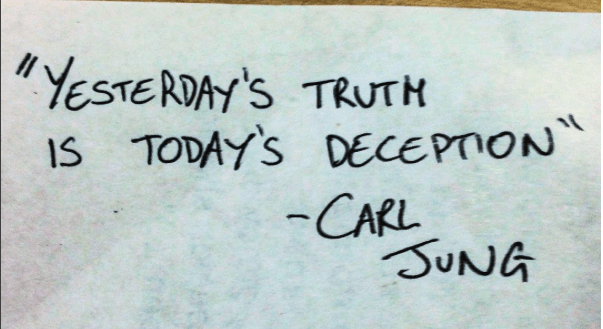
“Beware of wisdom that you didn’t earn.” – Carl Jung
“So we shall let the reader answer this question for himself: who is the happier man, he who has braved the storm of life and lived or he who has stayed securely on shore and merely existed?”
– Hunter S. Thompson
The following applies to coaching athletes as much as dealing with psychiatry patients…
Carl Jung on the Doctor/Patient relationship and methods in psychology:
Anyone who wants to know the human psyche will learn next to nothing from Experimental Psychology.
He would be better advised to put away his scholar’s gown, bid farewell to his study, and wander with human heart through the world. There, in the horrors of prisons, lunatic asylums and hospitals, drab suburban pubs, in brothels and gambling-hells, in the salons of the elegant, the Stock Exchanges, Socialist meetings, churches, revivalist gatherings and ecstatic sects, through love and hate, through the experience of passion in every form in his own body, he would reap richer stores of knowledge than text-books a foot thick could give him, and he will know how to doctor the sick with real knowledge of the human soul.
It is enough to drive one to despair that in practical psychology there are no universally valid recipes and rules.
There are only individual cases with the most heterogeneous needs and demands – so heterogeneous that we can virtually never know in advance what course a given case will take, for which reason it is better for the doctor to abandon all preconceived opinions.
This does not mean that he should throw them overboard, but that in any given case he should use them merely as hypotheses for a possible explanation.
An ancient adept has said: “If the wrong man uses the right means, the right means work in the wrong way.”
This Chinese saying, unfortunately only too true, stands in sharp contrast to our belief in the “right” method, irrespective of the man who applies it.
In reality, everything depends on the man and little or nothing on the method.
If we have to deal with the human soul we can only meet it on its own ground, and we are bound to do so whenever we are confronted with the real and crushing problems of life.
We would do well to abandon from the start any attempt to apply ready-made solutions and warmed-up generalities of which the patient knows just as much as the doctor.
Long experience has taught me not to know anything in advance and not to know better, but to let the unconscious take precedence.
“The man who is only wise and only holy interests me about as much as the skeleton of a rare saurian, which would not move me to tears.
The insane contradiction, on the other hand, between existence beyond Maya in the cosmic Self, and that amiable human weakness which fruitfully sinks many roots into the black earth, repeating for all eternity the weaving and rending of the veil as the ageless melody of India—this contradiction fascinates me; for how else can one perceive the light without the shadow, hear the silence without the noise, attain wisdom without foolishness?”
-Carl Jung
“…when I fall into the abyss, I go straight into it, head down and heels up, and I’m even pleased that I’m falling in just such a humiliating position, and for me I find it beautiful.”
– Dmitri Karamazov, from ‘The Brothers Karamazov’ by Fyodor Dostoyevsky
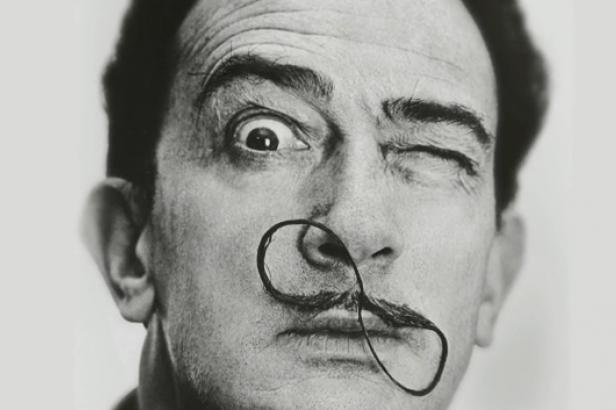
“The only difference between me and a mad man is that I am not mad.” – Salvador Dali
 Some Words Left Behind